Tuesday, March 8, 2022

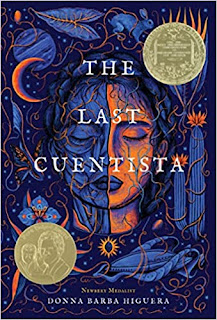
The Last Cuentista


A dystopian novel! What joy! Apart from a couple re-reads of The House of the Scorpion and The Giver, this is the first dystopian novel I have read in decades . . . and I've missed them. In fact, I only own 5 Newberys (I don't like having a lot of books . . . that's what libraries are for!) and two of them are dystopians (the ones mentioned above). So, the genre al
one had me hooked. 

Here is my recipe for The Last Cuentista:

2 cups Wall-E
1.5 cups The Giver
2/3 cup The House of the Scorpion
1 Tablespoon Interstellar 
1 teaspoon Nazis (pick any book depiction you like)

That's right; it's a space-travel dystopian novel with bad guys who champion same-ness and an ambiguous ending! 

Petra Peña, the protagonist, is really smart, resourceful, good at deceiving people and good at not getting caught. Like, too good at all those things. But the story wouldn't work if she wasn't, so I'll allow it. I mean, she has to pretend she's been brainwashed after 380 years in hyper-sleep and does a convincing job at age 13 while dealing with considerable personal trauma and loss? It's a stretch.

Like any futuristic dystopian story, I had a lot of questions. Is that what would really happen? Could a society like this really survive? Would those kids really have acted like that? Could the Collective really have changed their skin like that in just a few hundred years? How? What? What now?? But considering all these possibilities (and impossibilities) is really the reason these books are so appealing to me and The Last Cuentista did not disappoint, though I should note that this book will not be joining the ranks of my owned books. 


Wednesday, February 16, 2022

Red, White, and WHOLE

I am pretty sure* the last two Newberys I read that were written in verse were first person accounts of immigrants trying to navigate a new life in the United States (Other Words for Home and Inside Out & Back Again), so it felt comfortable and familiar to discover that this semi-autobiographical story of a second-generation American Indian girl was also written in verse! Reha's parents are from India, but she is born and grows up in the Midwest. Her story is poignant, well-written and TRAGIC. But, unfortunately, I've already started mixing it up with the other two free-verse immigrant Newberys.

*I just looked through the last decade of Newberys after making that claim and I stand corrected: Brown Girl Dreaming and The Crossover were also written in free verse and I've read those since Inside Out & Back Again.

Too Bright to See

When I first began this novel, I remarked to my husband, "I think it's weird that a tweener coming-of-age novel about a girl was written by a man. What would he know about what it's like to be a young girl?" Ha! Joke's on me. 

*SPOILER* Bug decides she's a boy by the end of the novel and the author is actually a trans-man who is  sharing his own experience as a child (in fictional format). 

This book left me feeling unsettled, uncomfortable, confused and a little sad. 

Thursday, April 8, 2021

All Thirteen: The Incredible Cave Rescue of the Thai Boys' Soccer Team

This book was mesmerizing and riveting and very informative. Christina Soontornvat takes a huge media story that I feel like most people probably heard about and makes it seem like an entirely new, fresh, nail-biting mystery. I mean, the very title makes it pretty obvious that all thirteen boys are going to make it out alive, but I still was nervous that it would actually happen until it did! That's good non-fiction story-telling right there. I also appreciate that the author tried to highlight everyone who contributed, especially those (mostly Thais) who didn't take the spotlight and do the daring cave scuba-diving but who provided materials, food, vehicles, prayers and days of endless service to make everything happen. Christina for the double-win in 2020!! (She is the first author, by the way, to win two honors in the same year for a fiction and a non-fiction book. And both were really good.)

Read it! Even if you watched the news coverage while it was happening, I promise you will be shocked by everything you didn't know.

Sunday, March 21, 2021

When You Trap a Tiger

 I did not enjoy When You Trap a Tiger. I thought it was slow and confusing and I never felt connected to any of the characters (Ricky was okay, I guess). It was honestly a bit of drudgery just to finish it. Apparently, the book's genre is "magical realism," which I discovered while reading reviews on goodreads to figure out why people liked it. Basically, the main character (Lily) is totally convinced that she sees and talks to a giant tiger and that doing what the tiger says (specifically, releasing stories from bottles) will save her halmoni (Korean grandma) from the brain cancer that is killing her. I kept thinking, "Wait, is she actually going down into the basement at 2 am to talk to a nonexistent tiger? Is she going to wake up and realize it's a dream to help her cope with grief and loss and her mom and sister mistreating her?" But she never wakes up, folks. She just talks to a giant, magical tiger the whole book long and then her halmoni dies and somehow the tiger helped her through it (the tiger is connected to the Korean folktales her halmoni told her growing up, but nothing was ever clear to me). 

Ok, things that didn't make sense:

1. The giant magical tiger Lily talks to.

2. How Lily's mom could uproot the entire family to move to a new state and NOT tell her kids that they're moving because her mom is dying of brain cancer. Like, why would she not have shared that with them? So confused.

3. Sam, Lily's teenaged sister, is a pessimistic jerk, but then hooks up with a super nice friendly cool girl over a period of 3 days (the entire duration of the book is about a week and Sam doesn't meet Jensen until day 4) and she sneaks out in the middle of the night to hang out with her and NOBODY has a problem with it, which makes me feel like the book is pushing an agenda.

4. Sam is mean to Lily and her mom all the time and that really never gets resolved.

5. Seriously, the tiger. What? Is Lily actually seeing a tiger or not? And if she is, WHAT?? And if she isn't, WHAT??


Wednesday, March 10, 2021

A Wish in the Dark


My favorite character in all of literature is the Bishop from Victor Hugo's Les Miserables (Ella from Ella Enchanted is a close second 😏). His compassion completely unravels me and his act of Godlike mercy in Jean Valjean's life has helped me understand Christ's love more than any other fictional character. So, when Father Chan first enters Pong's life, I was totally hooked on A Wish in the Dark. "He's just like the Bishop!" I thought. "Come to think of it, Pong is a lot like Valjean," I so cleverly observed. Then the moment when Pong is debating whether to release Nok from the barn jail cell, I was like, "Wait a friggin' second. This IS Les Mis! Did anyone else notice this? Am I the first to discover this amazing connection? Is the author sneaking in these hidden Hugo gems only for true Mizzies?" At this point, for the first time, I decided to read the blurb on the inside of the book's dust jacket . . . yep, it says her book is a twist on Les Mis. So every single person who reads the book knows this fact before they even start reading and I really did think I was so clever. 🤦


Also, though not to the same irresponsible degree, I thought I may be unique in noticing all the Thailand imagery and geography. On the first page when she describes the Chattana River, I immediately pictured the Chao Phraya river. When she calls the temple Wat Singh, though, I knew I had not discovered any kind of secret. Sure enough, the dust jacket blurb also reveals that this is a "Thai-inspired fantasy world." 

But what a combination, right? A modernish fantasy Les Mis story with non-suicidal tweener protagonists set in Thailand? Can you even imagine a lovelier premise? 

It really was as magical as it sounds.


Thursday, March 4, 2021

Box: Henry Brown Mails Himself to Freedom


I don't know how I've never before heard the story of Henry "Box" Brown who crammed himself into a box in Virginia and had his friend ship the box to the anti-slavery office in Philadelphia AND IT WORKED! I told my husband about his journey (during which he is placed upside down TWICE!) and he told me that being crammed into a teeny space and put upside down for hours at a time would be his worst nightmare. I thought that was an interesting sentiment because I felt very differently while reading this book. Slavery sounds much, much worse. Losing my spouse and kids because a slave-owner didn't keep his promise and sold them to a place I will never be able to find them would be a much greater nightmare. Taking a cramped and painful ride in a box for a few days actually sounds like a cake walk compared to the rest of Henry's life. 

The text of this very short book was written in "sixains" - poems with six lines - to represent the six sides of a box. While I appreciate the geometry connection, I didn't find the text particularly engaging and actually thought the poems made the story hard to follow.

Final Feeling: I am so glad that Henry Brown successfully escaped slavery through his own ingenuity and inspiration from God. But the fact that he never sees his wife Nancy and his four kids again makes this story a tragedy for me.