Friday, April 7, 2017

Freedom Over Me

I have spent several hours in the last two weeks researching my family history - looking through census records, cemetery files and genealogical indices for my ancestors. Why did great-grandma have three different daughters named Josephina? Did great-great-uncle Albert really never have any kids? Why does Theodore appear in the 1900 census record with his family but disappear in the 1910 census? You may not believe this when I say it, but those of you who have searched out your family will understand: Family history work is addicting. Just one more record . . . just one more son . . . three hours later . . .

So I was particularly interested in the author's origin story for this 50-page picture book: an original document appraising an estate in 1828. An image of that document appears in the first three pages and I was mesmerized, trying to read the handwriting and decipher the words. What makes this estate appraisal story-worthy (50 pages on an appraisement?!) is that it included people. Slaves. Eleven of them. And the author (Ashley Bryan, who happens to be 93 years old and male) creates and tells their stories - what they do for the Fairchild family, but also where they came from, who they love, what they miss and what they long for. The idea of this book was much more interesting to me than the actual book. I had a hard time connecting with the individuals' stories with only two pages of character development. The prose was nicely written, I guess, but not particularly engaging to me. The artwork was lovely, yes. And the author is 93. I might recommend this book based solely on that fact.

This is the page that had me hooked. Look at that document!


Tuesday, March 21, 2017

A Letter to the Author of The Girl Who Drank the Moon

Dear Kelly Barnhill,

Before this book becomes pervasive in all third grade classrooms and part of reading bowls and book battles across the nation (I'm too late, aren't I?), I would like to clarify here that I came up with the name Xan FIRST! Or maybe my friend Xan's mom and dad came up with it first and then I decided SECOND that it would be my daughter's name, but let it be known that Xan was my daughter's future name long before you made it the witch's name in The Girl Who Drank the Moon. My friend Xan actually came over last week for our annual pi day party and I showed her the book. She was fascinated! She flipped open to a page and, with mouth agape, exclaimed, "I've never seen my name in print so many times." Or ever? Anyway, I digress.
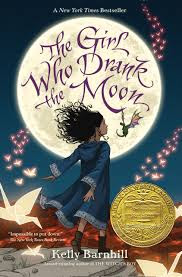
As cool as Xan, the benevolent witch, and Luna, the enmagicked (cool new word, Kel) young future-witch, and Glerk, the swamp monster/poet/god of the bog, are, my favorite character for the first 2/3 of the book was Antain. Dear, compassionate, intelligent, responsible, humble Antain. You foreshadowed from the very beginning that he would play a pivotal role in someday overthrowing the Elders' government and their terrifying baby-sacrifice tradition, but I was actually really disappointed by his function during the ultimate face-off. He was a strong character with incredible integrity until that final important scene on the knoll. Then suddenly he is this weak, pathetic,  vengeful person. It was so disappointing to me.

I thought the sorrow-eater was a very real-feeling villain. I've had some difficulty of late believing the evil of fictional villains. I have attributed that difficulty to my generally optimistic world view, but after reading this book, I'm convinced that authors are just not developing their bad guys well enough to be believable! The sorrow-eater's back story totally sold her as a real person who had allowed her real problems to slowly change her into a despicable sorrow-eater. Just the idea of sorrow eating was so fresh and new and interesting!

So, Kelly, even though you emasculated (not in the male role sense but in the strength of character sense) my favorite person in your novel, I was impressed with your creation of a credible malefactor with a unique criminal ability and I will still feel comfortable recommending your book to all my pre-teen friends (I have many). But just remember who came up with Xan first.

-Me

Thursday, March 9, 2017

The Inquisitor's Tale

It was clear from the text, author's note, annotated bibliography, author's bio, and multiple reviews that the author (and also, or, more accurately, because of, the author's wife) spent A LOT of time researching the Middle Ages. He and his wife could probably be described as obsessed with the Middle Ages, even. It's clear that one of his objectives in writing the book is to convince the reader that the Middle Ages are a fascinating time in the history of the world, worthy of much study. I must admit that the Middle Ages are no more fascinating to me nor am I any more likely to study them now than I was before reading The Inquisitor's Tale. But he wrote a good story with interesting characters, and that is all I really need.

I thought the organization of the book was a fun, unique approach - hearing the tale from a variety of people who had all experienced parts of it. But as is the case with most books written supposedly from multiple perspectives that I've read (The Help being a notable exception), I thought all the story-tellers sounded the same. The Jongleur does have a bit of a poorer vocabulary than the other narrators, but he still tells the story the exact same way. And all the story-tellers included parts of the story there is no way they could have known (the thoughts and feelings of other people) which made the coolness of different perspectives much less cool.

My favorite part of the book is a conversation between Michelangelo - a compassionate monk - and the three children (all with special abilities) he is shepherding. He is trying to explain the voice of God and how they can discern it in making decisions (a lifelong endeavor for me). I'll omit parts specifically related to the story (too complicated to explain) and just include his powerful advice:
"This is what I believe," Michelangelo agreed. "When I see you and William and Jacob laughing together - a peasant girl, an oblate, and a Jewish boy - I think, This is good. When I see petals fall from a pear tree at the end of spring, spinning like dancers to the ground, I think, This, too, is good. But what have they in common? And when a Jew is struck by a Lombard in the street, I think, This is very bad. And when a book is destroyed, I think the same thing. But what have those in common? What does a Jew have in common with a book? Children with petals spinning to the earth?"
A log cracked and fell into the fireplace. The smell of roasting wood wafted out into the room.
"I don't know, " Michelangelo said. "But I believe that it is the voice of God, telling me what to love and what to hate." 
 ...
But Jacob, suddenly, had doubts. "King Louis hates Jews," he said. "He probably feels that in his gut as well. And peasants, too. Is that God, telling him to hate me [a Jew] and Jeanne [a peasant]?"
Michelangelo sighed. "God is mysterious and works in mysterious ways. But Louis held Jeanne aloft and carried her around a room. He sat beside you both on our trip to Paris. I do not think he hates you. I think he has been taught to hate the idea of Jews and peasants. By his mother, by the church, by his lords - who benefit from exploiting their peasants and confiscating the Jews' money on the flimsiest pretenses. Distinguishing the voice of God and the voices of those around us is no easy task. What makes you special, children, beyond your miracles, is that you hear God's voice clearly, and when you hear it, you act upon it." He fixed Jeanne with his beady red-brown eyes. "So, will you act now?"
Well? Will you?
 

Monday, February 27, 2017

Wolf Hollow

I spent the first third of Wolf Hollow with a knot in my stomach because of the bully. I hate reading about bullies. This one made me uncomfortable and incredulous.  I kept silently yelling, 'Tell your parents, Annabelle!' And when she finally did, a weight lifted off my shoulders. I genuinely enjoyed the rest of the book.

Annabelle is my kind of heroine. I'm currently reading a best-selling YA series with a female protagonist who so many men are in love with (this series goes beyond the usual 2-suitor dilemma and gives her 3) and it's unrealistic to me since she doesn't seem all that cool. Contrasted with this somewhat empty heroine, Annabelle, who is wise and compassionate and courageous and clever, is inspiringly imitable. I love that she sneaks out to find and save Toby, that she asks him simple questions in the barn to help him feel at ease and trust her, that she has and implements the idea to hide him as a deer in plain sight, that she heeds the whispers to ultimately find Betty (the bully) in the well, and that she makes that risky but genius phone call to Andy.

The ending was sad and hopeful and it had a strange, powerful effect on me. But seriously, I actually felt a physical sensation in my chest last night while reading the last few paragraphs that went beyond an emotionally positive response to something somewhat spiritual? I read my scriptures just after I finished and the feeling stayed with me. Now, when I re-read these paragraphs by themselves in the daylight, they don't have the same effect on me. Clearly, my response was the result of the book in its entirety and the message, but I'll include the final passage here just to remember:
But Wolf Hollow was also where I learned to tell the truth in that year before I turned twelve: about things from which refuge was impossible. Wrong, even. No matter how tempting.
I told Toby as much, though I also said that I didn't blame him for fleeing the greater evils he'd known. And I thanked him for letting me try to right any number of wrongs, regardless of his own surrenders.
But the wind always swept my words away like cloud shadows, as if it mattered more that I said them, than who heard them.
And that was all right with me. 

Tuesday, November 22, 2016

Roller Girl

For the second year in a row, the committee has awarded a Newbery honor to a graphic novel! Not nearly as naive as I was way back in 2015, I saw GN on the spine of Roller Girl and immediately anticipated an entertaining and eye-catching read. I was not disappointed. There's just something so impressive about a good author who is also an incredible illustrator . . . and on top of being an incredible author-illustrator, Victoria Jamieson also skates on a roller derby team (Derby Name: Winnie the Pow). Can you get any cooler?

I'm inspired. Not to write a graphic novel (my lack of drawing ability would be too much of a handicap) . . . but to be a roller girl. Honestly, I think I could be pretty good. Then again, that's also what Astrid thought.


And then she attended her first day of roller derby camp.


Roller Girl Recipe:
1 cup G-rated Whip It
1 tsp El Deafo (yes, this has everything to do with the fact that it's the only other GN I've read)
3 Tbsp My 7th Grade Year (during which I did a lot of roller-blading, a lot of scoffing at girls who liked clothes and boys, and had lots of friend crises)

Recommendation: Read it! And then come join the Atlanta Rollergirls with me!

Thursday, October 13, 2016

The War That Saved My Life

This story has all the elements of a book that I would love. The novel is set in London during World War II, the protagonist is a headstrong young girl and all the main characters make significant, positive changes by the end of the novel. And yet . . . I didn't love this book.
And I'm not entirely sure why.

Perhaps it's because I found the abusive mother entirely unrealistic. I have a hard time believing that anyone could be that cruel and it just seemed too fictional for the story to feel real (historical fiction still needs to be believable, you know?).

Or maybe because I felt like the beautiful triumph of the book - Susan's love toward Ada and Jamie that allowed both of them to overcome their PTSD and myriad other issues - was overshadowed by some weird story about Ada catching a spy near the end. It was totally unnecessary and made Ada's progress and emotional victories seem less important.

And then there was the underlying, never-explicitly-mentioned fact that Susan had been in a lesbian relationship with her partner Becky until she had passed away a few years before (which threw Susan into severe depression) and I anticipated the entire book that the author would talk about it openly which made me very nervous for some reason - maybe because I felt it was too mature a theme for a children's book? Or because I felt like the author had an agenda? Maybe both?

Don't get me wrong; I liked the book. I just re-read over several parts (since I read it months and months ago) and there are so many heart-warming, redeeming moments: Ada making Christmas presents, Susan marching into Jamie's school to tell off the teacher for tying his left hand down, Ada learning to read and write, Stephen White's altruism toward the old colonel, even the Christmas Eve meltdown when Susan holds Ada for hours during her attack. There really are some very lovely parts . . . and yet.

Rating:«««

Monday, May 16, 2016

Echo

Echo comprises three stories inside a story inside another story. Maybe I could best describe it with an already solved SAT analogy test question.

INCEPTION : DREAMS :: ECHO : STORY LINES

Each of the stories was riveting and endearing, but I liked Friedrich's the best (a story about fighting injustice in Nazi Germany is pretty much a trump card for me) and Ivy's the least (even though her story starts in my hometown of Fresno). All five stories follow the pattern of a music-loving main character who experiences some extreme hardship (war, orphan-hood, segregation), but who finds solace in and even a slightly magical escape from hardship in the same enchanted Hohner harmonica. And the stories all reach a satisfying, if slightly kitschy, resolution in the end when the main characters all end up at the same concert at Carnegie Hall (some performing, one conducting, some attending) in the final chapter, though they are unaware they had all at some point in their lives played the same magical harmonica.

I found this book particularly enjoyable because I happen to be a music-loving main character who plays a Hohner harmonica (though I'm fairly certain it is not the same harmonica they all played . . . ) and I loved that each new story started with the harmonica tabs to a song played in the story. I made sure to play them all for my son (he wasn't a fan of Auld Lang Syne).


 Recommendation: Whole-hearted. Best read with a harmonica on hand.

And now for an irrelevant, but related, story.
While headed home last Christmas, I was stopped by Atlanta airport security because of something in my backpack. I quickly tried to take inventory of its contents and figure out what had alerted the guys at the x-ray machine, but I could think of nothing. I heard two of the guys talking about a 'magazine' before walking over to rifle through my bag in front of me and I thought, "My church magazines are a potential threat?!" Then I peeked at the x-ray screen and saw a circle drawn around something that looked startlingly like a magazine of bullets! How did THAT get in there? The man asked me if I had a harmonica in my bag and I told him I didn't think so, so we pulled a few things out and he ran the backpack through the machine again. The magazine of bullets was still in there hiding. He (we, actually, since I kept pointing out hidden zipper pockets where he might find my contraband) searched my bag again and this time uncovered . . . my Hohner harmonica. I sheepishly told the guy I had forgotten I packed it (was it still in there from my Thanksgiving camping trip when I thought I might play some tunes at the campfire?) and he let me go free. I purposely left it in my carry-on for the return flight in anticipation of another harmonica confrontation, but apparently the Salt Lake City airport does not care much about magazines of bullets in people's carry-on luggage.